Anthology
What It Actually Was
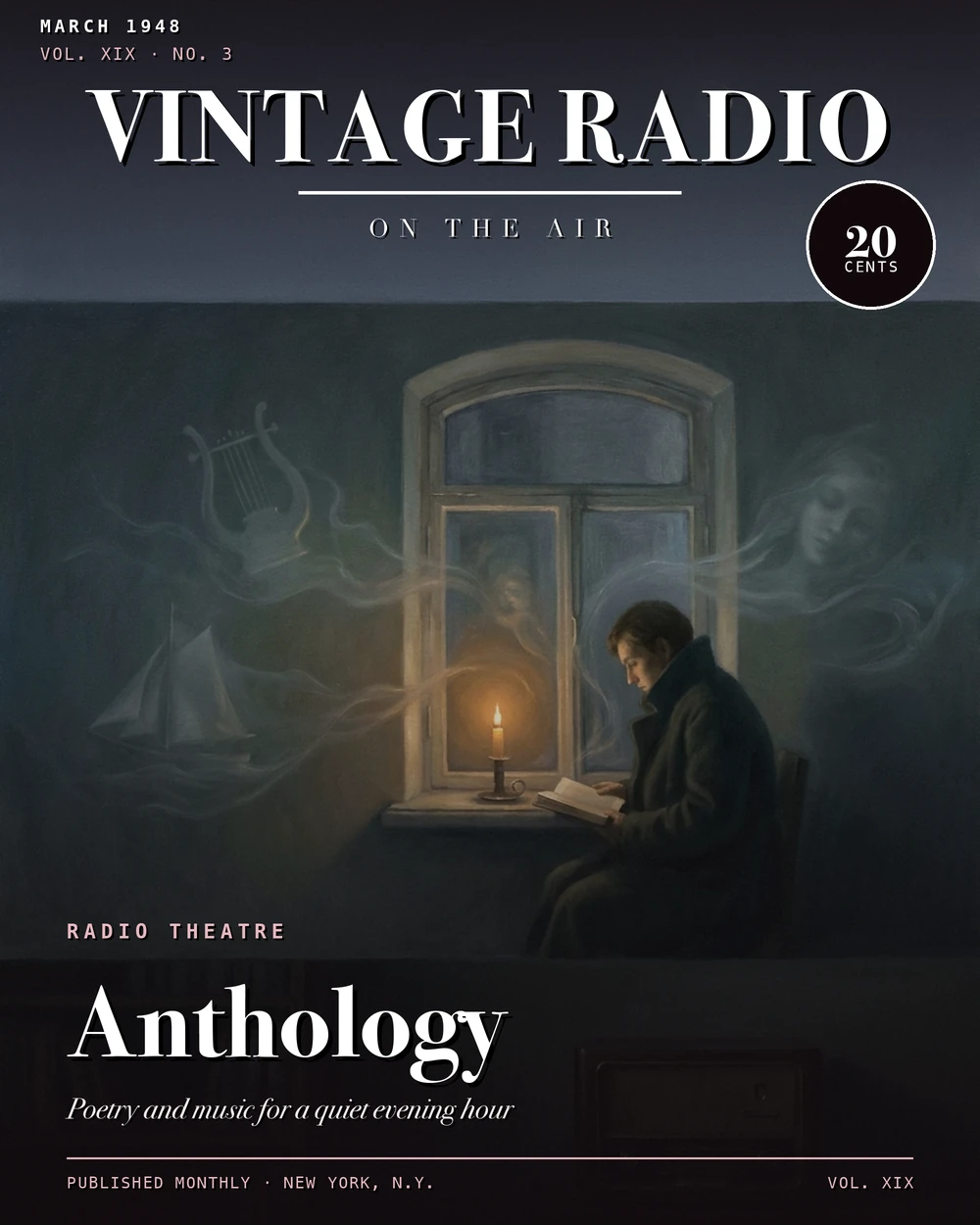
There is a temptation to hear "anthology series" and picture a dramatic radio program — actors in a studio, a thriller, a romance, a story with a beginning and an end. Anthology was something different. Broadcast on WNBC in New York from February 28, 1954 to June 12, 1955, it was primarily a poetry and spoken-word program, presenting verse on its own entertainment merits rather than as a classroom exercise or cultural obligation. Poetry was paired with appropriate classical music, read aloud by some of the most accomplished stage and radio voices working in New York at the time, and offered to listeners as a genuine evening's pleasure.
The series ran for 57 episodes across roughly sixteen months, long enough to build a consistent identity and a loyal audience. Its range was real — episodes devoted to individual poets, to national occasions, to French verse, to children's nursery rhymes, to biblical literature. What held it together wasn't a dramatic format but a sensibility: the conviction that poetry read well, in good company, was worth sitting with.
The 92nd Street Y Connection
Behind Anthology stood one of the most respected literary institutions in New York City: the Poetry Center of the 92nd Street YMHA — the Young Men's Hebrew Association. The Poetry Center had been established in the 1930s under Educational Director William Kolodney, and by the mid-1950s it was already a nationally recognized hub for live literary performance. Bringing that institutional weight to WNBC gave the series an authority that purely commercial programming rarely had.
The connection between the Y's Poetry Center and New York radio during this period ran deeper than a single series. WNYC, a sister New York public broadcaster, aired a separate program called Limited Edition in October 1954, also drawing on Poetry Center recordings from the 92nd Street Y. The same institutional source was feeding multiple outlets, which says something about both the volume of material the Poetry Center was generating and the appetite among New York broadcasters for literary programming at the time.
Harry Fleetwood and the Voice of the Program
The series was usually hosted by Harry Fleetwood, and the choice mattered. Fleetwood was already the host of WNBC's overnight classical music program Music Through the Night — a show that had itself grown out of a 1952 request from Civil Defense Authorities to keep a radio signal playing through the night. He had a reputation as a naturally civilized presence on air. Charles Osgood once described Fleetwood's appeal as being based on his being "so wonderfully civilized," and that quality shaped how Anthology felt from week to week.
Fleetwood stayed at WNBC until 1975, when he moved to WNYC to host classical music there. His association with New York broadcasting ran long and deep, and Anthology was one piece of a larger body of work. For the poetry series, his temperament set the tone: unhurried, attentive, without any of the showbiz energy that would have felt wrong for the material.
The Performers
The episodes that survive preserve readings by a remarkable range of figures. Bing Crosby, Helen Hayes, Frank Lovejoy, Lynn Fontanne and Alfred Lunt, Orson Welles, Agnes Moorehead, and Walter Huston all appear in the catalog — a roster that cuts across Hollywood, Broadway, and the classical stage. These were not obscure radio hands; they were performers with serious reputations who brought those reputations to the material.
Carl Sandburg read his own poetry on the series. Sandburg had a long history with radio — the National Park Service has noted that "thousands of Americans tuned in to hear Sandburg on shows over the airwaves" — and his appearance on Anthology fits that pattern. The episode dedicated to his work gave listeners something that recorded performance uniquely offers: the poet's own voice, his own timing, his own sense of where the weight in a line falls.
Ruth Draper, featured in the episode titled "The Art of Ruth Draper," brought a different kind of distinction. Draper was an acclaimed American monologist and actress who had dominated solo performance for decades, known for pieces including The Italian Lesson and Three Women and Mr. Clifford. She died in 1956, the year after the series ended, so her appearances in the catalog sit close to the end of her performing life.
What the Episodes Covered
The episode list is a map of the series' ambitions. Some episodes were devoted to individual poets: Wallace Stevens, Thomas Hornsby Ferrell, Carl Sandburg. Others addressed occasions — a salute to Lincoln, a Memorial Day broadcast in 1955, a Salute to Jewish Book Week. International literature got its due in episodes like "French Poetry" and "Thoughts and Stories of England." There were episodes for children ("Children's Poetry and Nursery Rhymes") and episodes tied to the liturgical calendar ("Poetry for Christmas," "Abraham and Isaac").
The episode titled "Mine the Harvest" — which appears at least twice in the catalog, suggesting unusual interest in the subject — takes its name from the posthumous 1954 poetry collection by Edna St. Vincent Millay. The book had been published by Harper & Brothers that same year, edited by Millay's sister Norma Millay, and her prominence as a subject shows how recently the series was engaged with contemporary literary life, not just the established canon. The title "Poetry of the Theater by the Theater and for the Theater" suggests the series also found ways to bridge its literary focus with the Broadway world from which many of its performers came.
How It Ended
Anthology concluded on June 12, 1955, after 57 episodes. It did not run long by the standards of commercial radio drama — series like Gunsmoke or Suspense measured their runs in years and hundreds of episodes — but it was never competing on those terms. It was a specialty program, produced in partnership with an institution whose mission was literary, broadcast on a network station willing to give serious spoken-word programming a place in the schedule.
What the series left behind is a record of what New York's literary and theatrical community sounded like in the mid-1950s, read and spoken by people who were at the center of it. The range of performers alone — Welles, Hayes, Moorehead, the Lunts, Sandburg reading himself — makes the surviving episodes a document of a particular moment in American cultural life, preserved in the format that suited it best.